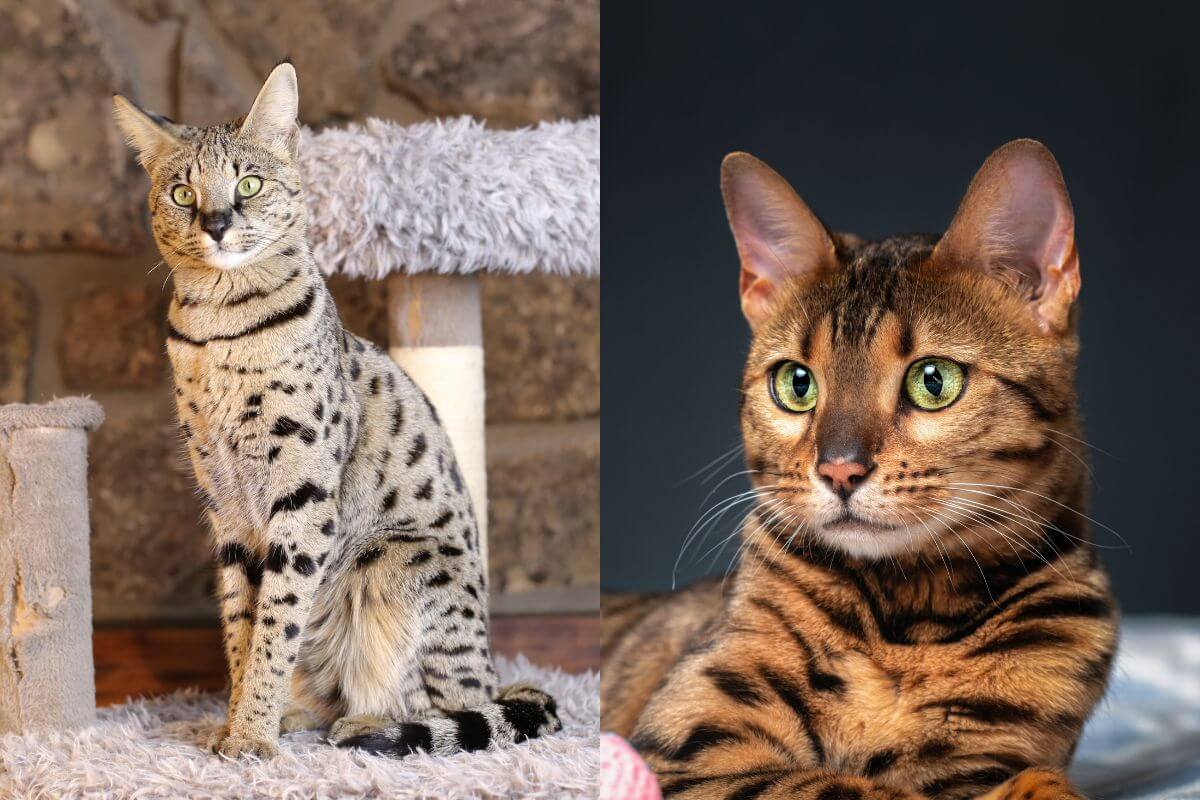
Exotic and charming, these felines have very distinct origins, behaviors and characteristics.
Savannah and Bengal cats attract attention with their wild and elegant appearance. At first glance, it is easy to confuse them, as they both have spotted coats, an athletic body and an energetic demeanor. However, despite the aesthetic similarity, these felines have very different origins, personalities and needs.
Below, discover some striking differences between Savannah and Bengal cats!
1. Origin and wild ancestor
The most important difference between the two breeds is in their origins. THE bengal It arose from the crossing between domestic cats and the Asian leopard cat, a small wild feline native to Asia. This mixture was developed to preserve the leopard’s wild appearance but domestic temperament.
The savannah, on the other hand, was born from the union between domestic cats and the African serval, a tall feline with big ears and a natural hunter from the African savannas. This direct inheritance gives him physical and behavioral traits closer to wild felines.
2. Body size and proportions
The Savannah is known for being one of the largest domestic cats in the world. It can exceed 40 cm in height and weigh between 10 and 15 kg, depending on the generation. Its body is thin, with long legs, a thin tail and an athletic appearance, reminiscent of a serval.
The Bengal has a more compact and muscular size, weighing on average 5 to 8 kg, with a strong and balanced body. Although it is also agile and athletic, it has a more proportionate and robust structure, which makes it look like a domestic “mini leopard”.
3. Shape of the head, eyes and ears
The differences in the face help a lot to distinguish the two races. THE savannah It has a triangular head, a narrower and elongated snout and large, tall and erect ears, positioned close to the top of the head — a clear inheritance from the serval. Its eyes are large and slightly slanted, giving it a wild and attentive expression.
The Bengal, in turn, has a more rounded head, with prominent cheeks, a short snout and medium-sized ears with rounded tips. Their eyes, usually green or gold, are expressive and convey curiosity and sweetness. His face is more “friendly”, while Savannah’s is more exotic and wild.
4. Coat pattern and coloring
Although they both have spotted coats, the patterns are very different. The bengal displays rosette-shaped spots, similar to those of leopards, as well as marbled versions, with striking contrasts and a known natural shine. Their colors can vary between brown, gold, silver and snow.
The savannah, in turn, has solid, rounded spots, well highlighted on a gold, beige or silver background. Its fur is short, dense and has a rougher feel. The marks are more spaced and contrast with the thin body, while the Bengal has a more closed pattern.
5. Behavior and energy level
The Bengal is extremely playful, curious and full of energy. He loves climbing, hunting for toys, playing with water and interacting with his owner. It is considered a cat with an “adventurous spirit” and tends to adapt well to the domestic routine, as long as it has daily stimulation.
The Savannah is even more active and requires a lot of space and attention. It likes to explore, run and jump to impressive heights, inheriting the serval’s vigor. It is common to see him accompany his owner around the house and even learn to use a leash for walks.
6. Wild instinct and territorial behavior
Because it has a higher percentage of serval genes, the savannah retains some behaviors typical of wild felines, such as a strong hunting instinct, territorial marking and initial distrust. It may be more difficult to socialize in the first generations and requires patience from the owner. The Bengal, although it is also agile and curious, has a more domesticated temperament. His behavior is predictable and he tends to adapt better to new people and environments.