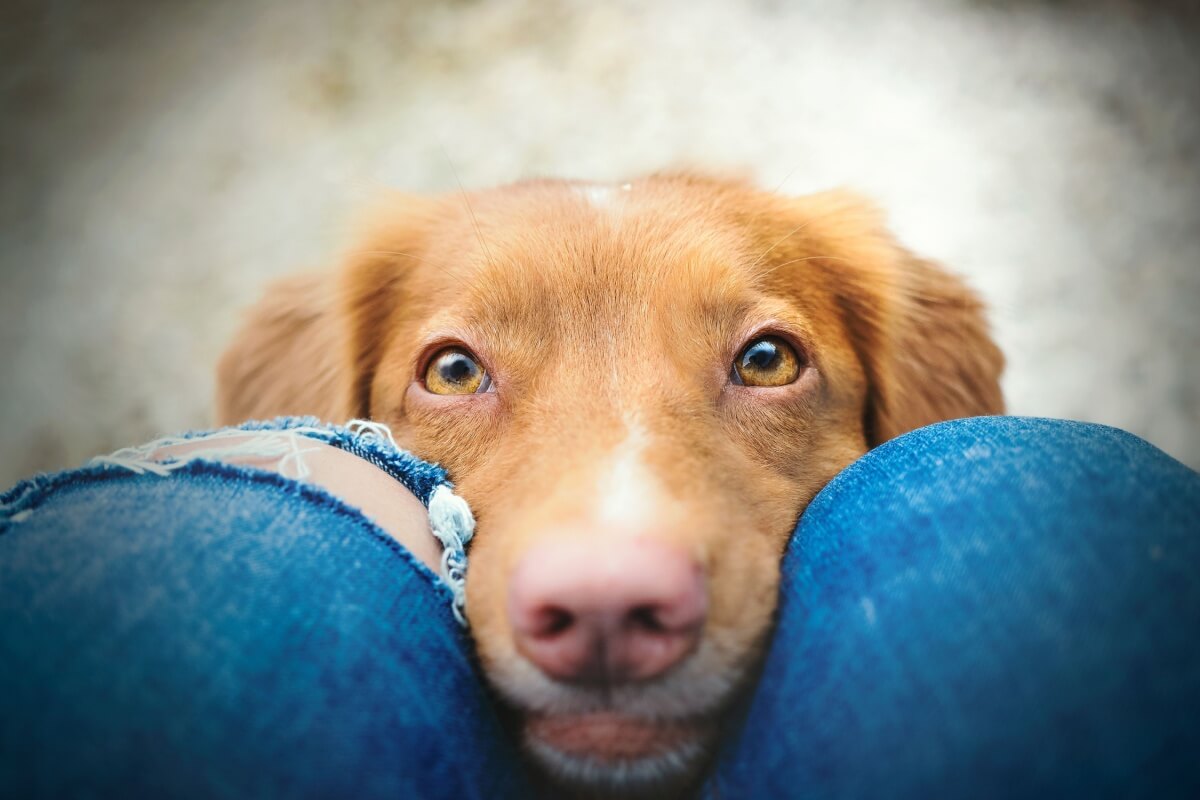
Understand how dogs’ eyes work and why they perceive their environment in a unique way on a daily basis
Vision, like hearing and smell, is a very important sense for the dog. Although many owners associate dogs mainly with their sense of smell, their eyes also play an essential role in how they interpret the environment, identify movements and interact with people and other animals. This set of senses works in an integrated way, helping the pet to orient yourself and protect yourself.
Although they don’t see all colors like humans, dogs don’t see the world in black and white. In fact, canine vision is quite different from ours in several aspects, from color perception to the ability to see in the dark. Below, check out some interesting facts!
1. Dogs see fewer colors than humans
Dogs have dichromatic vision, meaning they can perceive fewer color variations than humans. While we distinguish a broad palette, they see mainly shades of blue and yellow. This happens because they have fewer types of cells called cones na retina. This limitation does not harm the animal on a daily basis, as it depends much more on other senses. This explains why colorful toys don’t always attract as much visual attention.
2. They don’t see in black and white
A very common myth is that dogs see everything in black and white, but this is not true. Because they perceive some colors, the canine visual world is made up of softer, less varied tones. This difference occurs due to the structure of the eyes, which is adapted for other functions.
3. Dogs’ night vision is better
Os dogs They can see much better in the dark than humans. This happens because they have a greater number of rods in the retina, cells responsible for capturing light in low-light environments. Furthermore, they have a structure called bright carpetwhich reflects light inside the eye.
4. They are more sensitive to movement
One of dogs’ greatest visual abilities is detecting movement easily, even from a distance. This characteristic originates from their hunting ancestors, who needed to identify prey quickly. Dogs’ eyes are more efficient at perceiving moving objects than stationary ones. This explains why they react so quickly to balls, people walking or other moving animals.
5. The view of details is more limited
Compared to humans, dogs have lower visual acuity, meaning they see fewer details. Objects that are far away may appear blurrier to them. This characteristic is related to the way the retina is structured. Even so, this does not represent a significant problem, as the animal compensates for this limitation with its sense of smell and hearing.
Furthermore, dogs do not see objects that are very close to them well. muzzle. This is because their visual focus is not as finely tuned to short distances as humans. Therefore, it is common for them to use their sense of smell to investigate nearby items or to recognize people.
6. The field of view is wider
Dogs have a wider field of vision than humans, reaching around 240 degrees, depending on the breed. This happens because the eyes are positioned more laterally in the head. This adaptation allows them to better perceive what is happening around them, increasing their ability to detect possible threats or movements. It is an advantage inherited from its ancestors in the wild.
7. Some breeds see better than others
The quality of vision can vary greatly between different dog breeds. Dogs with a longer snout, for example, tend to have more distance vision, while those with a short snout may have more limitations. These differences are linked to the anatomy of the eyes and head.