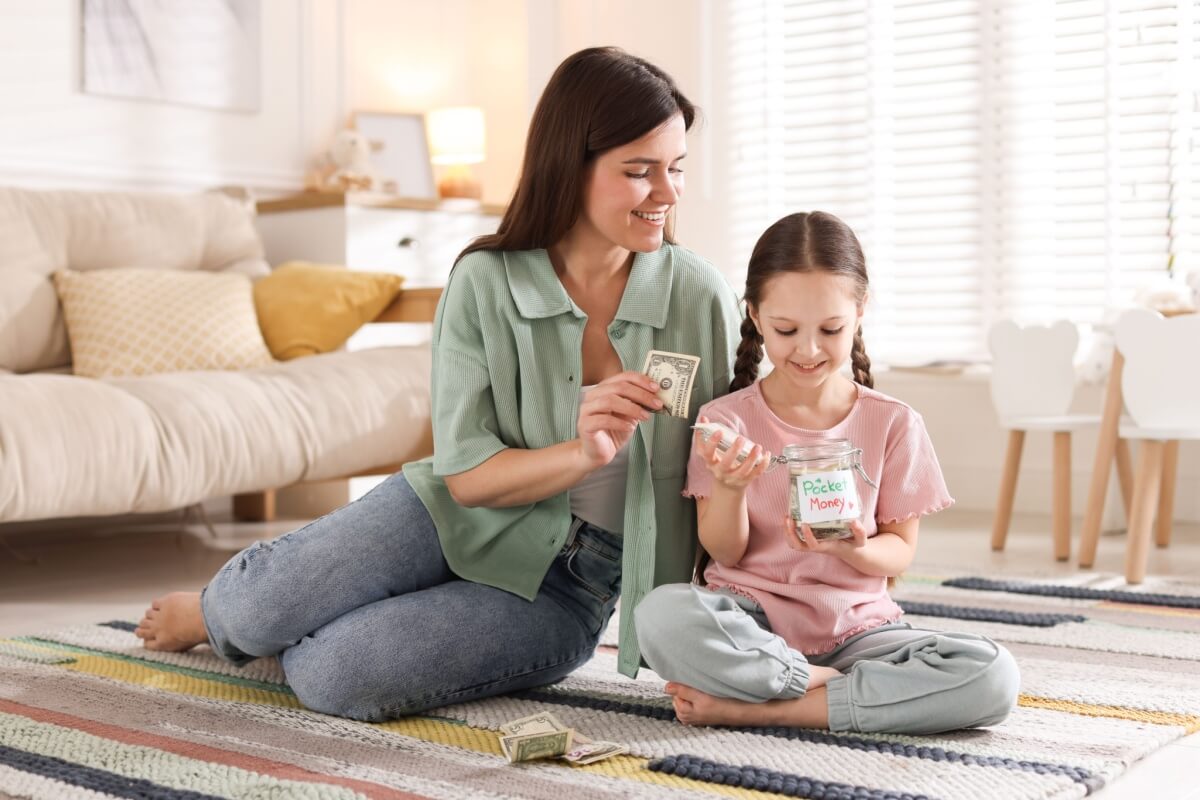
Practical activities and simple habits help children develop conscious consumption and responsibility at home and at school
EdiCase Editorial
It all starts with small choices. Learning the importance of a healthy diet, avoiding wasting water, food and energy, taking care of school materials and sharing with other people what is no longer used, but which is still in good condition, are simple attitudes that help to develop awareness, citizenship and a sense of commitment from an early age.
Situations that seem common to childhood are, in fact, the first steps towards developing responsibility for consumption at home. And it is not new that financial education has also been gaining ground within schools. One of the strategies is to bring the topic closer to students’ reality in a practical and accessible way, especially during Elementary School.
The proposal is to show that learning about financial choices is part of citizenship training. The initiative must be guided by the National Common Curricular Base (BNCC). In the document, which guides the organization of Basic Education throughout the country, financial education is among the Transversal Contemporary Themes. In practice, this means that the subject can be worked on in different curricular components and contexts, going far beyond Mathematics and stimulating reflections on consumption, organization and decision-making.
“In childhood, financial education begins to be developed in very simple everyday situations, such as learning to take care of one’s toys, making choices and even in daily planning, such as a shopping list, when possible. By developing this perspective from an early age, there is a greater chance of the child building a balanced relationship with consumption and planning”, explains Luana Baier, Mathematics content editor at Aprendi Brasil Educação.
Activities aimed at Elementary Education need to be designed to reflect the age range of students. In the initial years, the content appears in stories, activities fun and themed projects that help children differentiate between wants and needs. As school age advances, students begin to discuss planning, cooperation, organization and more conscious consumption habits.
Applying the principles of financial education at home
Learning about financial education can be strengthened with family participation, especially through situations experienced in everyday life. Conversations during the month’s shopping, the conscious use of financial resources, the setting of small goals or even decisions related to the reuse of materials help children and teenagers understand that money is directly linked to choices, priorities and consequences.
Luana Baier gives some examples of activities to apply the principles of financial education at home:
1. Needs x desires
Knowing how to differentiate between what we need and what we just want is one of the bases for a balanced relationship with money. And this distinction can — and should — be taught from an early age, in simple everyday situations.
“When you go shopping with your child, instead of just putting the products in the cart, give them a mission. Before you leave, make a list together of the items that need to be purchased. Then, when they ask for something extra, ask: ‘Is this a need? Or is this a want and we just want it for pleasure?'”, explains the expert. This is a way of applying the pillar of conscious consumption, which teaches children to prioritize what is a necessity and understand that the resource is finite, in this case, money.
2. The big dream
One of the prerogatives of financial education is to encourage planning. So, instead of just giving the child money, without talking about the destination or goal, try to talk to them and identify short-term goals, such as a toy, a book or a trip. Paste a photo of this goal in the pot or piggy bank that will be used to store the money. “This teaches gratifying waiting and financial planning. The child learns that saving is a tool to make future choices”, explains Luana Baier.
3. Budget small decisions
Luana Baier reminds us that children need to exercise autonomy, but with some type of supervision. “Give the child autonomy in controlled situations. Tell him, for example: ‘we have R$30.00 to choose the snack for today’s picnic. What is more worth buying?’. And then, let him compare prices and brands on his own”, he advises.
Situations like this work on decision-making and responsibility. When making mistakes — for example, buying something expensive that ends quickly — children learn the consequences of the choices they make in a safe environment, developing critical autonomy.
Financial education goes beyond learning linked to money
The expert reinforces, however, that financial education goes far beyond learning related to money. This is a topic that involves the development of habits, values and skills that contribute to more conscious and responsible choices throughout life. With children up to ten years old, this can be worked on through simple and meaningful experiences, such as reusing food in recipes – using fruit peels to prepare jellies, cakes and other recipes.
Com children and adolescents aged ten to 14, it is possible to expand this discussion by building compost bins, creating vegetable gardens at home or in communities, analyzing product labels and reflecting on topics that relate health, consumption and sustainability, for example.
This perspective is aligned with the concept of the Organization for Economic Co-operation and Development (OECD). Financial education is the process through which individuals and societies develop knowledge, values and skills that allow them to understand opportunities and risks, make informed decisions, seek guidance when necessary and adopt practices that contribute to their well-being and to the construction of a more responsible society committed to the future. In this way, it is not limited to the management of monetary resources, but also encompasses conscious consumption, the responsible use of natural resources, the appreciation of health and the development of citizenship.
By Caroline Giotti dos Anjos